I came to know text adventures a little after their heyday. It must have been around the early to mid 90's. After being gifted a TSR 80 Color Computer by my Grandad (my previous article of 14-03-2026 tells this story), I took plenty of time away from my Sega mastersystem and spent many hours combing over the instruction manual and typing in various program listings only half understanding the BASIC language I was coding.I paid particular attention to the games. I recall in particular a number guessing game in the form of Russian Roulette. These programs were primitive but my young imagination and lack of knowledge of what was and wasn't in scope of the computer's memory helped me feel as though as was one listing away from creating something akin to the super computer in Superman 3! Me, my brother and sisters thought that if we typed in everything from the manual the computer would get smarter and smarter until it was on parr with windows 3.1 or 95 which were both in circulation at the time if memory serves.
One day my dad passed a few issues of the Marshal Cavendish Input Magazine and I quickly discovered the programming course on text adventures. I was mesmerised by the idea of it, particularly the art style in the magazine.
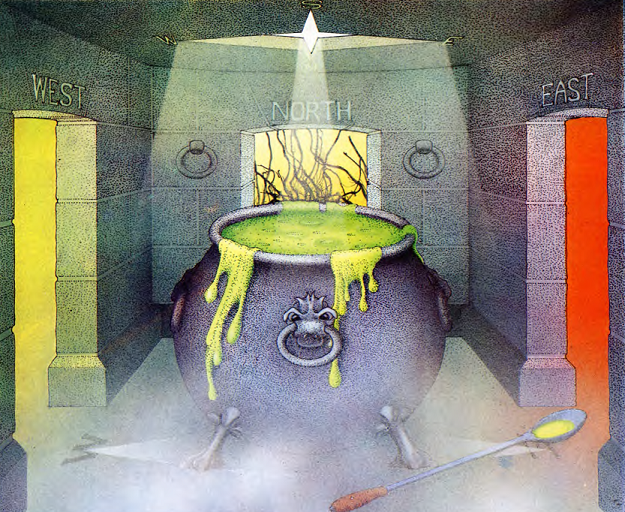
The image above is one example. It's from volume 1 - issue 9 of INPUT and depicts a bubbling cauldron in the midst of a mysterious fantasy world. The text below the image was the following:
"YOU ARE STANDING NEXT TO A VERY LARGE CAULDRON FULL TO THE BRIM WITH BUBBLING GREEN FLUID. THERE IS AN EVIL SMELL IN THE AIR. A SPOON LIES ON THE GROUND.
YOU CAN GO EAST WEST NORTH.
WHAT NOW?"
The magazine then went on to explain the context of all this:
"You now have to decide what you want to do. Should you use the spoon to stir the fluid, or even try drinking some? Should you leave it alone? Or should you explore, looking for a bottle or a container for the green fluid so that you can carry some with you?"
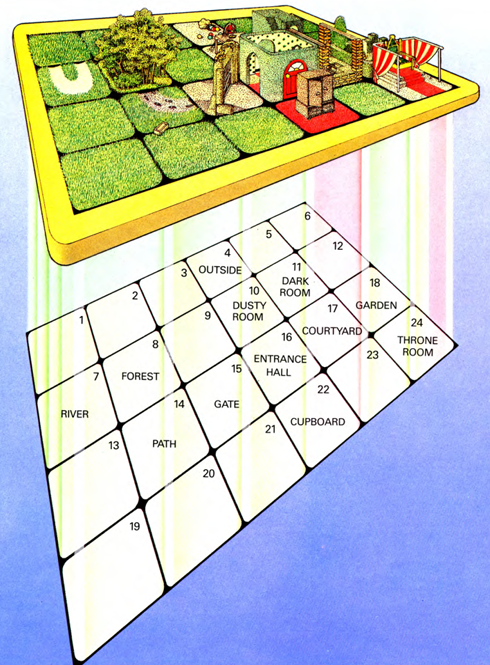
I found this very evocative at the time. I had a picture in my mind of how these games worked that was in hindsight nothing like the reality. I imagined vast and sprawling worlds that were cohesive, evocative and immersive. I imagined graphics very close to this the art on the pages of the magazine. I imagined parsers that were more sophisticated than today's A.I. language applications. This obviously wasn't the cause but I caught a text adventure bug right there and then and immediately dived in to typing the listings for a small text adventure game into my TSR 80. The text adventure example was a simple 11 location adventure set in a hidden city. The goal was to find the jewel encrusted eyeball whilst avoiding the tax inspector who would snatch objects away from the player. Below is an image that shows the map for the game. The art makes it seem incredibly incohesive as a game concept but I believe this to be intentionally. Although I have no idea why!
As you may recall if you read my previous blog entry though, I had no dataset to save the program so I had to keep my machine on day and night. It's important to note that we were quite a poor family who relied on an token electric meter. This meant that to keep the electricity supply to the house running we had to buy tokens and put them in the machine periodically. It was quite a reccurring event to have the power go out. So, it was a race against the clock and I always lost!
My Dad did once take me all over town looking in electronic shops to find a data cable that would fit the machine but of course nothing like that was sold anywhere because the machine was obselete. He had this crazy idea of hooking the Tandy up to a VCR and record the programs on VHS. He was all talk though and this project never saw fruition. You must bare in mind that in those days you couldn't just go on eBay!
A second problem surfaced after spending days typing out the code for the example text adventure in the magazine. One of the issues was missing and so I would never complete the program. At least not for a good few years. I had to learn BASIC and figure out a way to complete the program myself, which I eventually did, but long after the TRS 80 had been skipped. It was in QBASIC that I finally completed the program and I did it on a Windows machine. It was probably windows 98.
Reminiscing on all of this has made me want to revisit the program again. When I reached my early 20's I did go on ebay and I bought the entire collection of INPUT and have coded the example adventure many times since. I've translated it into QBASIC and coded it into a C64. However, one thing I never managed to do was use the program example to make my own game. Over the coming weeks (possibly months) I'm going to give this a good go. I have an idea for a game, which I will keep to myself for now but watch this space as I will attempt to document my process and also provide a copy of my game.